Established
The ingredients have defined functions within the physical formulation.
Topical delivery research
Can sodium bicarbonate be incorporated into a practical topical formula designed for use on working muscles before demanding exercise?
Executive summary
Sodium bicarbonate is well established as an oral sports-performance ingredient. In sufficient oral doses, it can raise blood bicarbonate and pH, increasing extracellular buffering capacity during intense exercise. Topical bicarbonate delivery is a much less established field.
Sodium bicarbonate is water-soluble and electrically charged in solution, while the outer layer of the skin is highly effective at limiting water-soluble and ionized compounds. A useful bicarbonate lotion therefore cannot be created simply by mixing baking soda into an ordinary moisturizer. It requires a complete system designed to suspend the mineral, maintain skin contact, manage the sensory experience, and investigate ways to reduce resistance presented by the skin barrier.
The ingredients have defined functions within the physical formulation.
Certain ingredients may influence skin permeability or sensory receptors based on research involving other compounds and formulations.
The finished formula has not been shown to increase muscle bicarbonate, change exercising-muscle pH, or improve athletic performance.
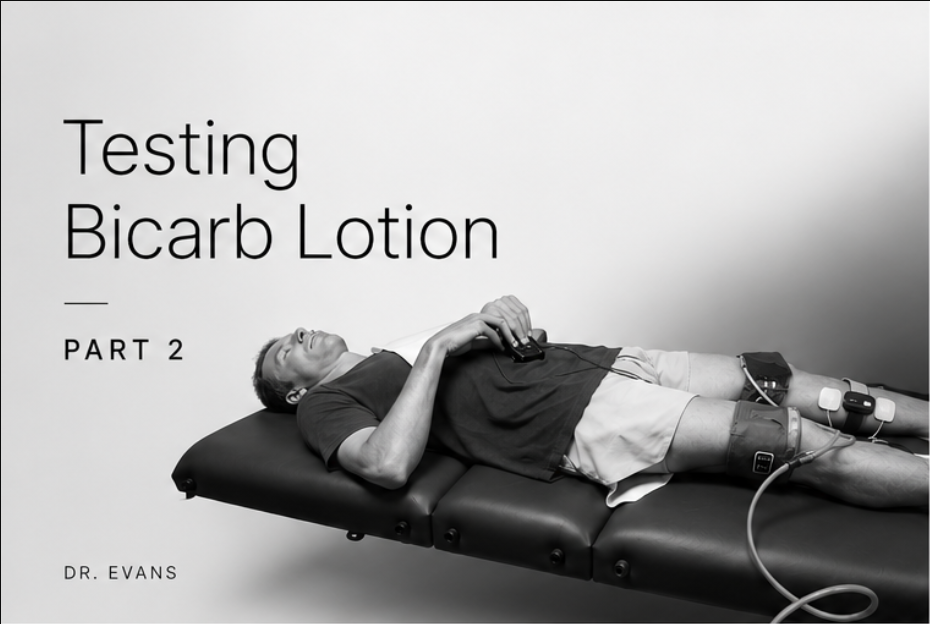
Video walkthrough
A two-part practical companion to the formulation science and responsible-use guidance in this paper.
Both videos open on the official Bicarb Instagram account.
01 / Why sodium bicarbonate?
During high-intensity exercise, ATP demand rises faster than aerobic metabolism alone can supply it. Increased glycolytic activity is accompanied by changes in hydrogen-ion handling, muscle pH, ion distribution, and excitation-contraction processes.
Bicarbonate is one component of the body's extracellular buffering system. Increasing extracellular bicarbonate through oral supplementation can strengthen the gradient supporting movement of hydrogen ions and associated metabolites away from working muscle.
Lactate itself is not the direct cause of fatigue. Lactate is an important metabolic intermediate and transport molecule. Fatigue during intense exercise is multifactorial and involves acid-base regulation, inorganic phosphate, potassium shifts, calcium handling, neural factors, substrate availability, and other processes.
Oral sodium bicarbonate has demonstrated performance benefits across several high-intensity exercise models, although the magnitude of benefit varies considerably between people and protocols.
Traditional oral bicarbonate protocols can cause bloating, nausea, cramping, diarrhea, or other gastrointestinal symptoms. A topical format is scientifically interesting as a potential platform for localized application, a simpler pre-exercise routine, and continued research into bicarbonate delivery. These are design objectives, not proof of physiological delivery.
Human skin is designed to keep external substances out. The stratum corneum is particularly resistant to the passive movement of hydrophilic, ionized compounds. Sodium bicarbonate dissociates into sodium and bicarbonate ions in water, making it fundamentally harder to transport across intact skin than many small, moderately lipophilic molecules.
02 / Formulation philosophy
Bicarb Lotion was not designed as a conventional moisturizer with sodium bicarbonate added as a marketing ingredient. The formula is organized into six functional layers.
Sodium bicarbonate provides the central mineral component and the basis of the product's research hypothesis.
Water, propylene glycol, dimethyl sulfoxide, and isopropyl alcohol create a mixed solvent environment for ingredients with very different chemical properties.
DMSO, propylene glycol, isopropyl myristate, isopropyl alcohol, and menthol have each been investigated for effects on the stratum corneum or the permeation of other compounds.
Polysorbate 80, hydroxyethylcellulose, and the oil components help maintain a usable, spreadable system containing dissolved and suspended materials.
Menthol and WS-3 create cooling sensations, while vanillyl butyl ether introduces controlled warmth.
Phenoxyethanol helps limit microbial growth in a water-containing formula that is repeatedly opened, handled, and stored.
Sensory intensity is not a direct measurement of bicarbonate absorption, muscle temperature, blood flow, or exercise readiness.
03 / Ingredient-by-ingredient rationale
Open each ingredient to see its role, why it was selected, and the boundary between formulation rationale and product-specific proof.
Principal carrier and aqueous medium for sodium bicarbonate and other water-compatible components.
Sodium bicarbonate requires an aqueous environment to dissolve and dissociate. Water also allows the formula to spread over a large muscle area without creating an excessively oily film. Water alone would provide poor texture, limited residence, inadequate preservation, and weak physical stability.
Defining mineral ingredient and basis of the product's research hypothesis.
Oral sodium bicarbonate is one of the most studied extracellular buffering agents in sports nutrition. The product was developed to investigate whether bicarbonate can be presented to the skin through a sophisticated delivery environment without a large oral dose.
Evidence for oral bicarbonate cannot be applied automatically to topical bicarbonate. The finished formula requires independent evidence of delivery, dose response, tissue-level change during exercise, and repeatable performance outcomes.
Co-solvent, humectant, wetting agent, sensory carrier, and potential skin-permeation modifier.
Propylene glycol helps bridge water-soluble, oil-soluble, and crystalline phases. It can alter the solubility and partitioning of other ingredients and has been widely studied in topical formulations, including combinations with lipid-soluble carriers such as isopropyl myristate.
Propylene glycol can cause irritant or allergic reactions in some users. Patch testing is appropriate.
Powerful polar solvent, co-solvent, and skin-permeation modifier central to the delivery hypothesis.
DMSO is miscible with water and many organic compounds. It has a long history of study as a percutaneous absorption enhancer and can affect solvent partitioning, skin proteins, and lipid organization in the stratum corneum. Its inclusion creates a more aggressive skin-interface system than a conventional cosmetic base.
DMSO does not prove bicarbonate reaches skeletal muscle. It may cause redness, dryness, warmth, itching, irritation, or a garlic-like odor after sufficient systemic exposure.
Apply only to clean skin, away from fragrances, pesticides, cleaners, medications, or other topical residues. Do not apply to punctured or damaged skin.
Volatile co-solvent, quick-drying agent, degreasing and wetting component.
Isopropyl alcohol improves evaporation and helps dissolve oil-soluble sensory components. Research with other topical compounds supports its role in the broader mixed-solvent formulation rationale.
Alcohol can increase dryness and irritation, especially on freshly shaved, abraded, or irritated skin, and can produce stronger stinging on a compromised skin barrier.
Nonionic surfactant and emulsifier.
Polysorbate 80 disperses oil-soluble ingredients through the water phase, supports consistency and physical stability, reduces large oil droplets, and improves spreadability and rinse-off.
Ingredient-level safety assessments do not replace preservation, irritation, and stability testing of the complete finished formula.
Lightweight emollient, oil-phase carrier, spreading agent, and skin-permeation modifier.
Isopropyl myristate creates slip without a heavy residue, distributes lipophilic sensory ingredients, and has been investigated as a vehicle that can interact with stratum-corneum lipids.
Immediate cooling sensation and activation of cold-sensitive sensory pathways.
Menthol activates the TRPM8 ion channel and gives the user a clear sensory indication that the lotion has been distributed over the intended area. It has also been studied as a chemical penetration enhancer for other molecules.
Cooling confirms sensory-receptor activation. It does not confirm deeper bicarbonate delivery, reduced muscle temperature or acidity, improved performance, or increased blood flow.
Synthetic cooling agent used to extend and sharpen the cooling profile.
WS-3, or N-ethyl-p-menthane-3-carboxamide, produces cooling through cold-sensitive pathways including TRPM8. It creates a cleaner, more sustained cooling sensation without relying only on additional menthol.
WS-3 is a sensate, not a proven sports-performance ingredient.
Controlled warming sensation.
This vanilloid-related warming compound creates a slower warmth beneath the rapid and sustained cooling signals from menthol and WS-3, producing a more complex sensory progression.
Warmth or redness should not be presented as proof of increased muscular blood flow or microcirculation unless directly measured in controlled testing.
Emollient, oil-phase carrier, sensory-ingredient solvent, and skin-feel modifier.
Medium-chain triglycerides provide a limited oil phase for hydrophobic compounds, add slip and conditioning, and help moderate the drying effects of alcohol and the concentrated mineral phase.
Primary rheology and suspension agent.
Hydroxyethylcellulose increases viscosity, slows particle settling, limits dripping, improves dose control, creates a lotion-like texture, and extends surface contact.
No suspension system permanently eliminates settling. Shaking very well before use redistributes the mineral phase and is part of correct product use.
Primary preservative for the water-containing formula.
Phenoxyethanol provides broad preservation support across a wide range of cosmetic ingredients and pH conditions. Preservation is essential for a product exposed to hands, travel, repeated opening, and warm storage environments.
Ingredient safety does not prove the finished formula is adequately preserved. The final product should undergo recognized preservative-efficacy or microbial challenge testing in its final packaging.
04 / Why multiple delivery ingredients?
| Formulation problem | Selected approach |
|---|---|
| Bicarbonate requires an aqueous phase | Purified water |
| Oil- and water-soluble ingredients must coexist | Propylene glycol, DMSO, and polysorbate 80 |
| The skin limits passive movement | DMSO, propylene glycol, isopropyl myristate, alcohol, and menthol |
| Mineral particles may settle | Hydroxyethylcellulose |
| Alcohol and mineral content can feel harsh | Medium-chain triglycerides and isopropyl myristate |
| The user needs an application signal | Menthol, WS-3, and vanillyl butyl ether |
| Water creates microbial risk | Phenoxyethanol |
| Product may remain too wet | Isopropyl alcohol |
| Product must spread over large muscles | Mixed solvent, oil, and surfactant system |
A strong delivery vehicle still requires direct validation. Mechanistic plausibility is the beginning of product development, not the end of it.
05 / Microneedling and the skin barrier
Microneedles and dermarollers create temporary microscopic channels through the stratum corneum. They have been investigated in pharmaceutical research as a way to increase delivery of compounds that cross intact skin poorly. A device does not, however, selectively increase bicarbonate movement; it may increase exposure to several formulation ingredients at the same time.
Bicarb has not established that combining a dermaroller with this formula safely increases bicarbonate delivery, provides a predictable dose, improves exercise performance, prevents excessive ingredient exposure, or is appropriate for repeated unsupervised use.
The FDA states that authorized microneedling devices have been reviewed for limited aesthetic uses and are not approved for delivering cosmetics, creams, gels, drugs, or other products into the skin. The risks of combining microneedling with topical products are not known.
Apply Bicarb Lotion only to clean, dry, intact skin. Do not apply immediately before or after dermarolling, microneedling, shaving, or any procedure that punctures or damages the skin barrier.06 / What users may feel
The skin has highly responsive temperature and irritation receptors. A small quantity of a sensate can create a strong feeling without producing an equivalent change in deep muscle.
Cooling is not proof of bicarbonate delivery.
Warmth is not proof of increased muscle blood flow.
Tingling is not proof that the product is working.
Greater burning does not mean greater effectiveness.
A strong or painful sensation is a reason to remove the product, not a desirable dose response.
07 / Current evidence for topical bicarbonate
A 2023 study applied a commercially available sodium bicarbonate lotion to both legs of nine participants at rest and reported changes in intramuscular dialysate pH and serum pH. It is noteworthy because it attempted to measure a signal within skeletal muscle.
A randomized study published in 2020 found that a topical sodium bicarbonate product did not meaningfully alter blood-buffering capacity or improve exercise performance in trained or untrained participants.
Another study involving soccer players found that topical bicarbonate did not accelerate recovery after exercise-induced muscle damage and did not reproduce the performance effects observed with oral bicarbonate.
08 / Safety and responsible use
Applying a mixed-solvent formula over another product creates an uncontrolled mixture directly on the skin. Do not apply over sunscreen, insect repellent, fragrance, massage oil, topical medication, cleaning-product residue, agricultural chemicals, or unknown substances.
Use a small amount on an intact area and observe both the immediate response and the skin later that day. Temporary coolness, warmth, or mild tingling may occur. Pain, blistering, pronounced swelling, or persistent dermatitis is not an intended response.
Bicarb Lotion was built as a disciplined platform for topical bicarbonate research. Its public claims should evolve only as product-specific safety, delivery, physiological, and performance data become available.
Return to Bicarb Lotion